


Most relationship problems are not really about what was said. They are about how it was said, and what was heard.
Communication styles in relationships shape nearly every interaction you have with a partner, a friend, or a family member.
Two people can want the exact same thing but walk away from a conversation feeling unheard or dismissed simply because they communicate differently.
Understanding those differences can reduce conflict, deepen connection, and help the people in your life feel genuinely seen.
What are Communication Styles?
Communication styles are the natural patterns people use to share information, express feelings, and respond to others. They develop over time through upbringing, personality, past experiences, and cultural background.
When people ask what communication styles are, the answer goes beyond just talking. It includes tone, body language, listening habits, how someone handles disagreement, and how they respond under pressure.
In relationships, these patterns matter. When two people share compatible styles, conversations tend to flow without much friction.
When styles clash, simple discussions can turn into arguments, and emotional needs often go unmet.
Understanding your own style of starting the conversation and the style of the people you are close to is the first step toward a better connection.
The 7 Communication Styles Explained
When most people ask what the 7 communication styles are, they are referring to a set of patterns widely recognized in psychology and communication research. Here is a breakdown of each one, with examples drawn from real relationship situations.
| Style | Core Trait | How It Shows Up in Relationships |
|---|---|---|
| Assertive | Direct and respectful | Honest, balanced conversations |
| Aggressive | Forceful and blaming | Power struggles, resentment |
| Passive | Conflict-avoidant | Bottled emotions, unmet needs |
| Passive-Aggressive | Indirect and resentful | Hidden tension, confusing signals |
| Manipulative | Calculated influence | Distrust, emotional exhaustion |
| Empathetic / Collaborative | Active listening, compromise | Deep connection, joint problem-solving |
| Analytical / Logical | Fact-focused and rational | Practical but sometimes emotionally distant |
Assertive
Assertive communication is widely regarded by therapists and communication researchers as the most effective style for healthy relationships. Assertive communicators say what they mean, respect other people’s boundaries, and do not avoid important conversations out of fear.
In a relationship: “I felt hurt when our plans changed without a heads-up. Can we talk about it?” That is assertive. Direct, honest, and not blaming.
Pros: Builds mutual respect, reduces long-term conflict, and makes both people feel heard. Cons: Can feel confrontational to someone who prefers indirect communication.
Aggressive
Aggressive communication puts winning above understanding. It often involves raised voices, blame, criticism, and a need to dominate the conversation rather than resolve it.
In a relationship: “You always do this. You never think about anyone else.” The focus is on attack, not resolution.
Pros: In the short term, it may feel like problems are handled quickly. Cons: Damages trust, creates fear, and often causes the other person to shut down entirely.
Passive
Passive communicators avoid expressing their real feelings or needs to sidestep conflict. They agree on the surface while feeling differently inside.
In a relationship: A partner who always says “I’m fine” or “Whatever you want,” even when they clearly are not fine.
Pros: Keeps the peace in low-stakes situations. Cons: Unexpressed needs eventually surface as resentment or emotional withdrawal.
Passive-Aggressive
This style sits between passive and aggressive. Instead of expressing displeasure directly, passive-aggressive communicators use sarcasm, the silent treatment, or indirect actions to signal frustration.
In a relationship: Agreeing to help with something, then “forgetting” to do it. Or responding to a sincere question with a cutting remark.
Pros: Temporarily avoids direct confrontation. Cons: Creates confusion, erodes trust, and makes genuine resolution difficult.
Manipulative
Manipulative communicators work to influence others by playing on emotions, guilt, or insecurity. It can be subtle and difficult to identify at first.
In a relationship: “I guess I’ll just handle everything myself, like always” is a guilt-based statement designed to prompt a reaction rather than open a conversation.
Pros: None that support healthy relationships. Cons: Severely damages trust and can cause lasting emotional harm, especially in long-term relationships.
Empathetic / Collaborative
This style prioritizes understanding over being right. Empathetic communicators listen actively, validate feelings, and look for solutions that work for everyone.
In a relationship: “I can see this situation is really stressful for you. What would help right now?” That is collaborative communication in action.
Pros: Builds closeness, reduces misunderstandings, and creates a safe space for honesty. Cons: If overextended, the collaborative communicator may suppress their own needs to keep the peace.
Analytical / Logical
Analytical communicators focus on facts and solutions. Emotions tend to take a back seat in how they process and respond to situations.
In a relationship: During an argument about feeling neglected, an analytical partner might respond by listing times they did show up, rather than acknowledging their partner’s feelings first.
Pros: Useful for practical decision-making and keeping conversations grounded. Cons: Can feel cold or dismissive toward partners who need emotional acknowledgment before solutions are offered.
How Communication Styles Affect Relationships
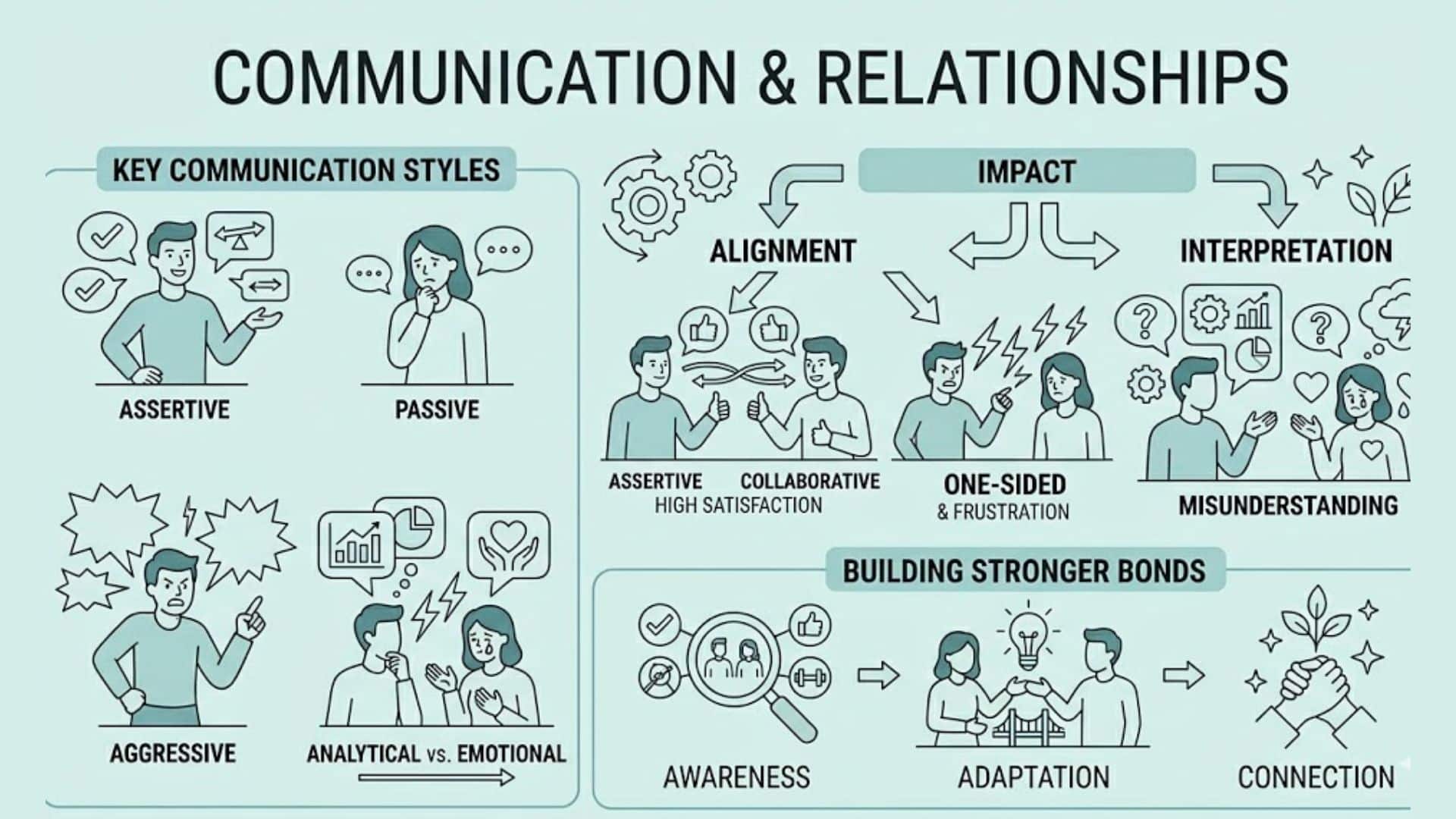
According to the American Psychological Association, understanding communication styles in relationships helps explain why conflicts arise and how people connect. Knowing your own style and recognizing others’ can improve understanding and strengthen bonds.
- Alignment or clashes between communication styles strongly impact long-term relationship satisfaction.
- Assertive-passive and aggressive-empathetic pairings can create frustration or one-sided dynamics.
- Misinterpretations arise when analytical or indirect comments are received differently by emotionally expressive partners.
- Couples with open, direct communication (assertive/collaborative) report higher satisfaction than those with avoidant or hostile patterns.
Awareness of communication styles allows relationships to grow with less misunderstanding and more connection. Adapting and respecting different styles fosters healthier, more satisfying interactions over time.
Identifying Your Own Communication Style
Before you can change anything, you need a clear picture of where you stand. A few ways to get there:
Reflect on recent conflicts
Think about the last disagreement you had. Did you speak up clearly, avoid the issue, or say something indirect? Your default during conflict reveals a lot.
Take a structured assessment
The Thomas-Kilmann Conflict Mode Instrument (TKI) and the communication dimensions within the Myers-Briggs Type Indicator are two widely used tools for identifying your natural tendencies.
Ask someone who knows you well
A trusted friend or therapist can often name patterns you have not noticed in yourself.
Notice your stress response
Most people default to a different style under pressure. You might be collaborative most of the time, but slide into passive-aggressive behavior when you feel unappreciated. That shift is worth knowing about.
The goal is not to judge your style but to understand it well enough to work with it.
Conclusion
Communication styles in relationships touch nearly everything, from how couples handle disagreements to how friends express support and how families work through tension.
There is no single perfect style, but there are patterns that build closeness and patterns that create distance over time.
The more clearly you understand your own defaults and the styles of the people you care about, the better positioned you are to communicate with intention rather than habit.
Start with self-awareness, apply one or two of these strategies consistently, and give yourself and others room to grow.
Frequently Asked Questions
What are the Most Common Communication Styles?
The most common styles are assertive, aggressive, passive, and passive-aggressive. Empathetic, manipulative, and analytical styles are also recognized.
Can Communication Styles Change Over Time?
Yes, communication styles can change through self-awareness, experience, and practice. Patterns from childhood can shift with effort and guidance.
How Do I Handle Conflicts With a Passive-Aggressive Partner?
Address behavior without accusation: “I feel like something is bothering you. Can we talk?” Couples counseling may help if patterns persist.